
Montenegro: The Balkans' Most Breathtaking Secret
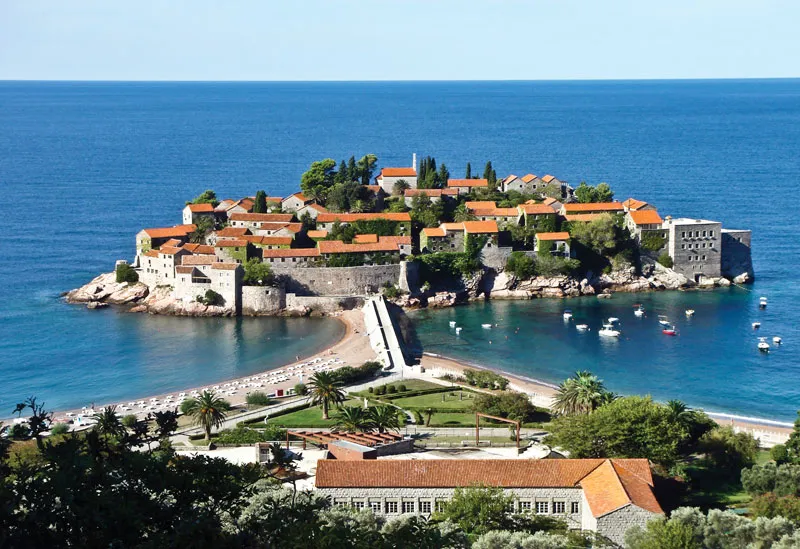
Source: Britannica
Though it is one of the smallest countries in Europe, Montenegro packs an unbelievable amount of natural beauty and deep history into its borders. Its name literally translates to "Black Mountain," but the landscape is a brilliant canvas of emerald-green rivers, deep-blue Adriatic waters, and terracotta-roofed medieval towns.
Whether you are navigating the serpentine roads of the high Alps or strolling through Venetian-style coastal villages, Montenegro offers a profoundly authentic travel experience. Here is your factual guide to exploring the jewel of the Adriatic.
1. The Bay of Kotor: Europe’s Southernmost Fjord
The Boka Kotorska (Bay of Kotor) is a stunning, deeply indented bay surrounded by dramatic, near-vertical limestone cliffs.
- Kotor Old Town: This UNESCO World Heritage site is a maze of cobblestone streets, hidden piazzas, and ancient stone churches. The Old Town is pedestrian-only, making it incredibly peaceful to explore early in the morning.
- The City Walls and San Giovanni Fortress: For the best view of the bay, you must climb the ancient city walls. Be prepared: it is a steep climb of over 1,300 steps. During the main tourist season, accessing the main path costs €15. Insider Tip: If you want a more rugged hike, take the centuries-old "Ladder of Kotor" trail that zigzags up the mountain just outside the North Gate; it is free and offers equally spectacular panoramic views.
- Perast: Just a 20-minute drive from Kotor is the sleepy, picturesque town of Perast. From here, you can take a quick, inexpensive boat ride out to Our Lady of the Rocks, a stunning 17th-century church built on a tiny, man-made islet in the middle of the bay.
2. The Connectivity Reality: Why You Need an eSIM
Here is a vital logistical tip for traveling in Montenegro. While the coastal towns are well-connected, exploring the true beauty of the country requires driving into the rugged interior, where navigation can get tricky.
The Navigation Challenge
- Serpentine Roads: The mountain roads—like the famous Kotor Serpentine—are incredibly beautiful but winding and steep. You will rely entirely on live GPS to navigate safely and check real-time traffic conditions.
- The Roaming Trap: Because Montenegro is not in the European Union, standard EU roaming packages often do not apply. Relying on your home carrier can result in shocking daily data charges.
The Solution: The eSIM To ensure you hit the ground running, purchase a Montenegro-compatible eSIM data plan before you fly.
- The Benefit: An eSIM connects you instantly to local networks the moment you arrive. It ensures you have immediate bandwidth to load your offline maps, translate Montenegrin road signs, and coordinate with local tour operators without ever hunting for a physical SIM card shop.
3. The Wild North: Durmitor National Park
Leaving the coast and heading north completely changes the landscape. Durmitor National Park is a dramatic alpine wonderland and a UNESCO World Natural Heritage site.
- The Peaks and Glacial Lakes: The park features 48 peaks towering over 2,000 meters and 18 breathtaking glacial lakes. The most famous is Crno Jezero (Black Lake), which is easily accessible and surrounded by dense pine forests.
- Tara River Canyon: Cutting through the park is the Tara River Canyon. At up to 1,300 meters deep, it is the deepest canyon in Europe. The water is a striking, luminescent teal, and rafting down the Tara River is widely considered one of the best outdoor adventure experiences on the continent.
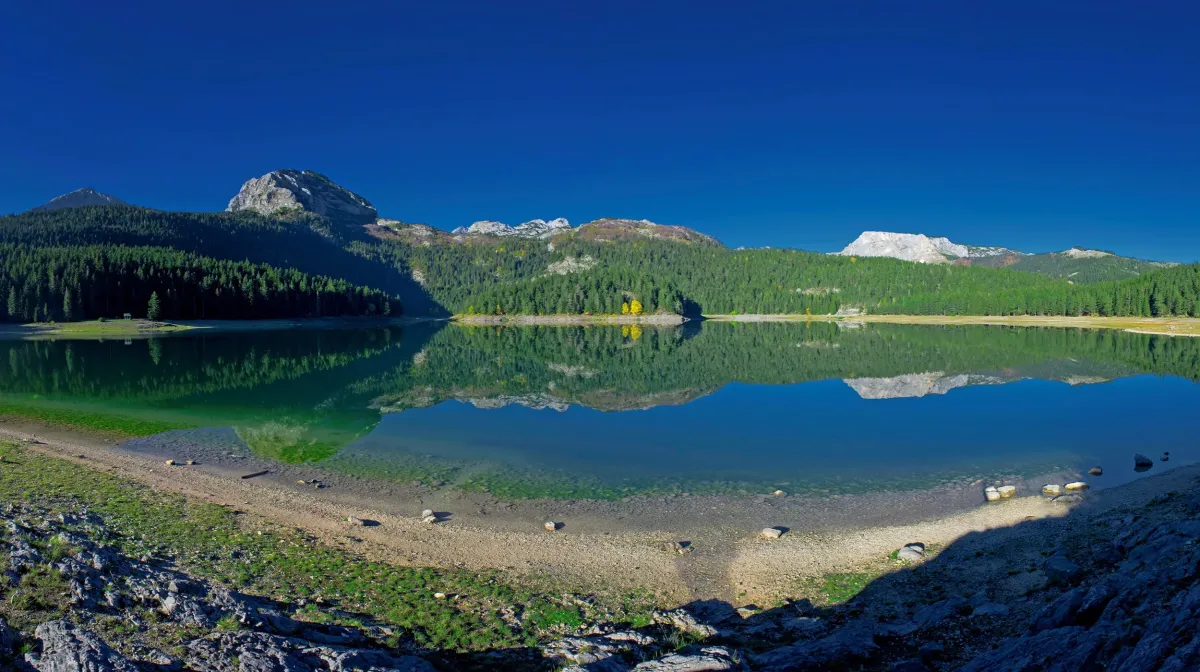
- Source- National Tourism Organisation of Montenegro
4. Lake Skadar: A Naturalist’s Paradise
Shared between Montenegro and Albania, Lake Skadar is the largest lake in the Balkan Peninsula.
- The Landscape: The Montenegrin side is a protected national park characterized by steep mountains plunging into calm, lily-pad-covered waters.
- The Wildlife: It is one of the most important bird reserves in Europe, home to over 260 species. Taking a traditional wooden boat tour out onto the lake is the best way to spot the rare and majestic Dalmatian pelican.
5. A Taste of Montenegro
Montenegrin cuisine is heavily influenced by its geography. The coast relies on the Mediterranean sea, while the mountainous north focuses on hearty, comforting dairy and grains.
- Kačamak: The ultimate mountain comfort food. It is a dense, savory porridge made from cornmeal and mashed potatoes, heavily mixed with melted local cheeses and clotted cream (kajmak).
- Fresh Seafood: Along the coast, you will find an abundance of fresh Adriatic catches. Whole sea bream or sea bass, simply grilled with olive oil, garlic, and parsley, is a staple of the coastal diet.
- Burek: A beloved breakfast pastry found in almost every bakery. It is made of flaky, layered phyllo dough traditionally filled with cheese, spinach, or minced beef.
- Shopska Salad: A wonderfully refreshing side dish made of roughly chopped tomatoes, cucumbers, and onions, smothered in a thick layer of grated white cheese.
- Priganice: These are small, airy balls of fried dough. They are typically served hot and meant to be dipped in local mountain honey or savory cheese.
Why Go Now?
Montenegro is a destination that rewards the curious traveler. It offers the dramatic coastal beauty of its more famous neighbors without the overwhelming crowds. By securing your digital connection with an eSIM and bringing an appetite for adventure, you are ready to uncover the spectacular secrets of the Black Mountain.