
Ghana: The Gateway to West Africa
Source: visitghana.com
If you are looking for an introduction to West Africa, Ghana is the perfect handshake. It is often called "Africa for Beginners," but that nickname feels like a disservice. It implies simplicity, when in reality, Ghana is a deep, complex, and vibrant nation that hits you with a wall of humidity and history the moment you step off the plane.
It is a land where ancient slave forts stand as silent guardians over bustling fishing villages. It is where you can walk on canopy bridges suspended in the rainforest in the morning and eat spicy Jollof rice in a modern city by sunset.
If you are ready to experience the heartbeat of West Africa, here is your factual guide to the land of the Black Star.
1. Accra: The City That Never Sleeps
Your journey begins in Accra, a sprawling metropolis that is equal parts chaotic and charming.
- Jamestown: This is the oldest district in the city. dominated by the red-and-white striped Jamestown Lighthouse. Walking here is intense—it is a fishing community where thousands of colorful wooden canoes line the shore. The smell of smoked fish and the sound of Ga fishermen singing as they haul nets is overwhelming in the best way.
- Black Star Square: Visit Independence Square to see the massive arch that symbolizes Ghana's freedom from British rule in 1957. It is vast, imposing, and a critical photo op.
- Makola Market: If you want to see commerce in its rawest form, go here. You can buy anything from giant land snails to colorful wax print fabrics (Ankara). It is loud, crowded, and hot. Watch your pockets, but don't fear the crowd—people are generally incredibly helpful.
2. Cape Coast: The Heavy History
Drive three hours west to the Central Region. This is the emotional core of any trip to Ghana.
- Cape Coast Castle: This UNESCO World Heritage site was one of the "Grand Slave Emporiums" of the trans-Atlantic trade. You will walk through the "Door of No Return," where millions of enslaved Africans took their final steps on the continent. Standing in the dark, damp dungeons while the guide explains the history is a harrowing, necessary experience.
- Elmina Castle: Just a short drive away lies Elmina, the oldest European building in sub-Saharan Africa (built by the Portuguese in 1482). It is older, starker, and surrounded by a vibrant harbor full of flags and boats, creating a jarring contrast between the tragic past and the lively present.
3. Kakum National Park: Walking in the Clouds
Just north of Cape Coast lies Kakum.
- The Canopy Walk: This is the highlight—a series of seven suspension bridges hanging 40 meters (130 feet) above the rainforest floor. The bridges sway as you walk, offering a view of the canopy usually reserved for birds and monkeys.
- The Wildlife: While you are unlikely to see forest elephants (they are shy), you will hear the forest alive with hornbills and parrots. Go early in the morning (arrive by 8:00 AM) to beat the heat and the school groups.
4. The Connectivity Reality: Why You Need an eSIM
Here is a logistical reality check. Ghana is a mobile-first nation. You pay for coconut water with Mobile Money (MoMo), you order your Uber or Bolt (which are safer and cheaper than street taxis) via app, and you navigate the unmarked streets with Google Maps.
The "Sim Registration" Headache Ghana has strict SIM card registration laws. To buy a local SIM, you must visit an official office, present your passport, provide biometric data (fingerprints/facial scan), and wait for the system to register you. The queues at the airport MTN shop can be hours long.
The Solution: The eSIM To avoid spending your first 4 hours in Ghana standing in a line, purchase a Ghana-specific eSIM data plan before you fly.
- Why? An eSIM allows you to connect to local networks immediately upon landing at Kotoka International Airport (ACC).
- The Benefit: You can bypass the SIM registration bureaucracy completely. You will have data instantly to order your Uber from the arrivals curb and to WhatsApp your guesthouse owner. In a country where street addresses are often vague ("Turn left at the blue container"), having a working phone is a safety necessity.
5. Mole National Park: The Safari Surprise
Most people don't associate West Africa with safaris, but Mole National Park in the north changes that.
- The Elephants: Mole is famous for its walking safaris. You don't just sit in a jeep; you walk with an armed ranger. It is common to get within 20 meters of massive African elephants bathing in the watering holes.
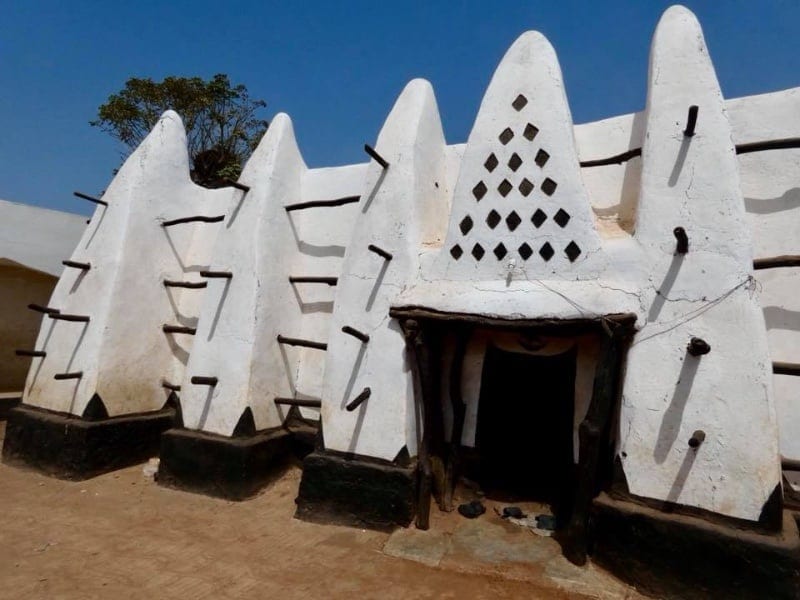
- The Larabanga Mosque: Just outside the park is the "Mecca of West Africa," a mud-and-stick mosque dating back to 1421. It is a stunning example of Sudanese-style architecture, painted gleaming white against the red dust of the north.
- Source- visitghana.com
6. The Food: Jollof Wars and Fufu
You cannot visit Ghana without eating.
- Jollof Rice: This is the national obsession—rice cooked in a rich, spicy tomato stew. Warning: Do not tell a Ghanaian that Nigerian Jollof is better. This is a diplomatic incident waiting to happen.
- Fufu: Starchy dough made from pounded cassava and plantain, swallowed whole (not chewed) with a light soup (usually goat or groundnut soup). It is heavy, filling, and delicious.
- Kelewele: Spiced fried plantains sold on street corners at night. They are seasoned with ginger and pepper and are the perfect evening snack.
7. Practical Survival Tips
The "Yellow Card" Rule
- Mandatory: You cannot enter Ghana without a Yellow Fever vaccination certificate. They check it before immigration. If you lose it, they will vaccinate you at the airport for a fee (which you want to avoid).
Money Matters
- Cash is King: While hotels accept cards, you need Ghana Cedis (GHS) for everything else.
- The "Fresh Note" Rule: If you bring USD to exchange, the bills must be "big heads" (printed after 2013) and in pristine condition. No tears, no ink marks. Damaged bills will be rejected by forex bureaus.
The "Dash"
- Tipping, or "dashing," is common. It is a gesture of appreciation. A few cedis to a helpful guide or someone who watches your car goes a long way.
Why Go Now?
Ghana is currently championing the "Beyond the Return" initiative, welcoming the African diaspora and tourists alike with open arms. The energy is infectious. It is a country that is reclaiming its narrative, mixing a tragic history with an irrepressible joy. Whether you are dancing to Afrobeats in Osu or standing in silence at Elmina, Ghana demands to be felt, not just seen.