
Chad: The Saharan Secret You Have to Earn
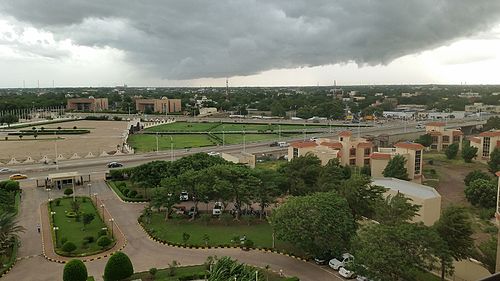
Let’s be clear from the start: Chad is not a beginner’s destination. It does not have resort pools, it does not have English menus, and it certainly does not have paved roads where you are going.
But if you are the kind of traveler who feels like the world has become too mapped, too curated, and too crowded, Chad is your antidote. It is a vast, landlocked titan in North-Central Africa that holds some of the most dramatic landscapes on Earth. From the "Miracle of the Sahel" in Zakouma to the prehistoric rock cathedrals of the Ennedi, Chad is raw, silence-filled, and achingly beautiful.
It is a difficult trip to plan, but for those who make it, it is often the journey of a lifetime. Here is your guide to the final frontier of African travel.
1. Zakouma National Park: The Miracle
If you know African wildlife, you know the tragic stories of poaching in the 80s and 90s. Zakouma is the opposite of that story. It is widely regarded as one of the greatest conservation success stories on the planet.
- The Experience: Located in the southeast, this park has bounced back from the brink. Today, it is teeming with life. In the dry season, you can see herds of thousands of tiang antelope, buffalo, and the rebounding Kordofan giraffe population.
- The Elephants: The park is famous for its massive herds of elephants. unlike the scattered families you see elsewhere, here they often move in "super-herds" of hundreds to protect their young—a behavior learned during the poaching wars. Seeing 400 elephants moving as a single grey wall through the dust is a sight that will stay with you forever.
- Logistics: You generally stay at Tinga Camp (budget/mid-range) or the ultra-luxe Camp Nomade. The park is only accessible during the dry season (roughly November to May).
2. The Ennedi Massif: The Stone Garden
In the northeast of the country lies the Sahara, but not the flat, boring kind. The Ennedi Massif is a sandstone plateau eroded by wind and time into a labyrinth of arches, pillars, and canyons.
- Guelta d’Archei: This is the postcard shot of Chad. A guelta is a natural water pocket in the desert. Here, hundreds of camels are driven by semi-nomadic Tubu herders to drink every day. Their grunts echo off the towering canyon walls.
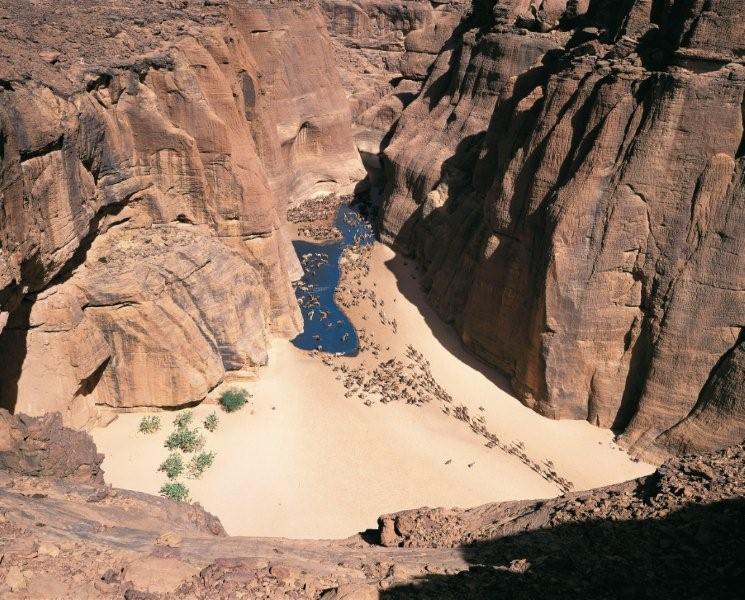
- Source- Desertman, CC BY-SA 3.0, via Wikimedia Commons
- The Survivors: Look closely at the dark water. The Guelta is home to a relict population of West African Crocodiles. They have survived here since the Sahara was a lush savannah, trapped by the encroaching desert. They are smaller than Nile crocs and feed on fish and camel droppings.
3. The Lakes of Ounianga
Further north, deep in the hyper-arid desert, you will find a miracle: a series of 18 interconnected lakes.
- The Colors: The Ounianga Lakes are a UNESCO World Heritage site. Some are fresh, some are saline, and they shimmer in colors ranging from blue to green to red. Seeing sapphire-blue water surrounded by golden sand dunes and palm trees looks like a computer-generated mirage, but it is real.
4. Practical Logistics: The "Hard" Stuff
Chad requires serious preparation. You cannot simply show up.
The Visa Maze Getting a visa for Chad is notoriously difficult. You will almost certainly need a Letter of Invitation (LOI).
- The Fix: Do not try to backpack Chad alone. Book a tour with a reputable operator (like African Parks for Zakouma or a specialized Saharan expedition company). They will provide the LOI you need to apply at the embassy.
- Police Registration: Upon arrival in N'Djamena, you must register with the police within 72 hours. Your hotel or tour operator usually handles this, but ensure it gets done to avoid fines when leaving.
Safety & The "Red Zones"
- The Reality: Large parts of Chad are dangerous. The Lake Chad region (West) and the borders with Libya and Sudan are strict "No-Go" zones due to terrorism and kidnapping risks.
- The Strategy: Stick to the "safe corridors": N'Djamena, Zakouma, and the guided flight/convoy routes to Ennedi. Never travel overland at night.
Cash is King
- Currency: Central African CFA Franc (XAF).
- Exchange: Credit cards are useless outside of the top hotel in N'Djamena. Bring Euros (not Dollars) to exchange. The rate is fixed (655 XAF = 1 Euro), making the math easy.
5. The Connectivity Challenge (And Why You Need an eSIM)
Here is the reality of communication in Chad: It is sporadic, but when you need it, you really need it.
N'Djamena has decent 4G, and even remote towns like Fada (the gateway to Ennedi) are starting to get signal. However, buying a local SIM card is a headache. It involves finding an open shop, dealing with a language barrier (French/Arabic), and a lengthy registration process involving passport photocopies and fingerprints.
The Solution: For your safety and sanity, purchase a regional eSIM data plan before you fly.
- Safety Line: In a country with a volatile security situation, being able to check travel advisories, message your tour operator, or use GPS the moment you land in N'Djamena is a safety necessity, not a luxury.
- The Gap: While your eSIM won't work in the deep desert (you'll need a satellite phone for that, usually provided by your guide), it bridges the critical gap during transit in the capital. It avoids the vulnerability of wandering around the city looking for a SIM vendor.
Why Go Now?
Chad is one of the last places where you can feel like an explorer rather than a tourist. The silence of the Ennedi desert at night, under a sky crushed by stars, is absolute. It is a destination that demands resilience, but rewards you with a planet that looks exactly like it did 10,000 years ago.