
A 5-Minute Guide to the Castles, Cornflowers, and Concrete of Belarus
Source: Google User Content
For most travelers, Belarus is a blank spot on the map. It is often described in political shorthand—"Europe’s Last Dictatorship" or a "Soviet Time Capsule"—but these labels miss the nuance of a country that is undeniably beautiful, deeply tragic, and fascinatingly complex.
To visit Belarus is to step into a version of Europe that feels parallel to the one you know. It is a land where ancient UNESCO castles sit near pristine primeval forests, and where the capital city’s skyline is a monumental tribute to Stalinist Empire style. It is not a destination for the casual tourist, but for the curious traveler, it is a revelation.
If you are looking to explore the path less traveled—literally—here is your guide to Belarus.
Minsk: The Solar City
Your journey begins in Minsk, a capital that was almost completely destroyed in World War II and rebuilt from the ashes with a grand, specific vision.
- The Architecture: Walking down Independence Avenue (Praspiekt Niezaliežnasci) feels like walking through a movie set. The buildings are massive, symmetrical, and imposing—a style known as "Stalinist Empire." It is awe-inspiring in its scale. The streets are famously, almost unnervingly, clean.
- The National Library: You cannot miss it. Shaped like a rhombicuboctahedron (a giant diamond), this futuristic library is the symbol of modern Belarus. At night, its LED facade turns into a massive light show. Go to the observation deck on the 23rd floor for the best view of the city’s sprawling green parks.
- Upper City (Verkhny Gorod): For a glimpse of pre-war Minsk, head here. It’s a small, restored district of cobblestone streets and churches. In the summer, it comes alive with street musicians and open-air jazz.
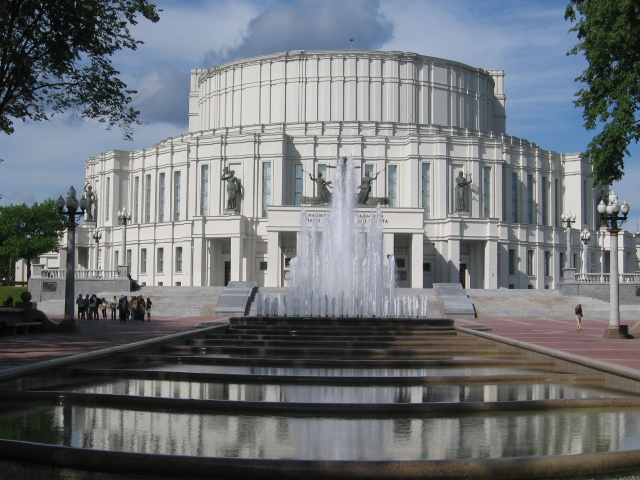
Belarusian National Academic Opera and Ballet Theater. Source- Gruszecki, CC0, via Wikimedia Commons.
The UNESCO Twins: Mir and Nesvizh
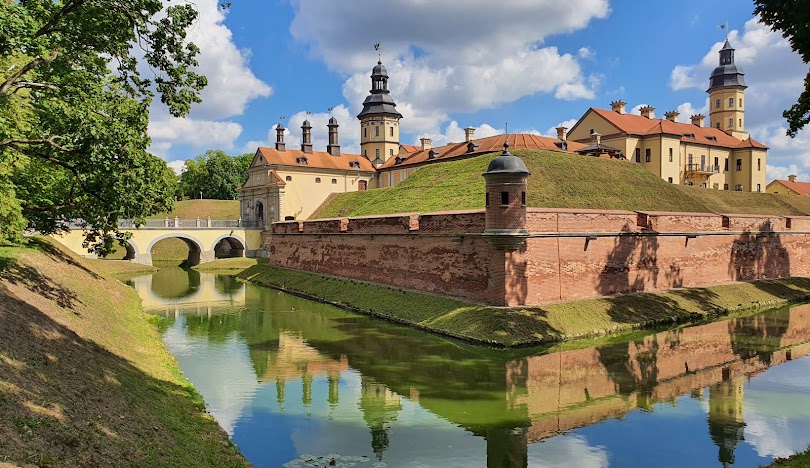
Drive 90 minutes southwest of Minsk, and the Soviet concrete gives way to medieval aristocracy. Belarus is home to two of Eastern Europe’s most stunning castles.
- Mir Castle: A 16th-century fortress that looks like it belongs in a dark fairytale. With its red brick towers and gothic accents, it reflects the turbulent history of the region, having been owned by Polish-Lithuanian nobility. You can climb the narrow, winding staircases inside the towers for views of the surrounding lake.
- Nesvizh Palace: Just 30km from Mir, this was the residential palace of the powerful Radziwill family. It is vastly different from Mir—more refined, sprawling, and baroque, surrounded by massive landscaped gardens. The interiors are restored to their golden, velvet-draped glory.
Brest Fortress: The Hero
On the border with Poland lies the city of Brest. The main draw here is the Brest Fortress, a site of immense emotional weight.
- The History: This is where the Soviet Union held out against the initial Nazi invasion in 1941. The resistance was fierce and tragic.
- The Monument: The centerpiece is the "Courage" monument—a colossal stone face of a soldier emerging from a massive rock, looking defiant. The scale of the statues and the somber silence of the complex make it one of the most powerful war memorials in the world.
Belovezhskaya Pushcha: The Land of Giants
Straddling the border between Belarus and Poland is Europe’s oldest surviving forest, Belovezhskaya Pushcha.
- The Bison: This ancient woodland is the home of the European Bison (Zubr). These massive animals—the heaviest land mammals in Europe—were brought back from the brink of extinction. Seeing a herd of them moving through the mist of the primeval forest is a bucket-list experience for nature lovers.
Practical Tips: The Logistics of the "Unknown"
Traveling to Belarus requires more preparation than a weekend in Paris. The rules are strict, and the geopolitics are real.
1. The Visa Situation For years, Belarus offered a "30-day visa-free" regime for citizens of 70+ countries (including the US, UK, and EU), provided you flew in and out of Minsk National Airport and did not arrive from or depart to Russia.
- Note: Land border crossings (bus/train) usually require a traditional visa. Always check the absolute latest entry requirements before booking, as they can change overnight.
2. Money: The "Cash" Reality Due to international sanctions, many Western credit cards (Visa/Mastercard issued abroad) do not work in Belarus.
- The Fix: You must bring cash (Euros or US Dollars). The bills must be crisp and new; exchange bureaus will reject torn or marked notes. You exchange them for Belarusian Rubles (BYN) upon arrival. Do not rely on your card.
3. Staying Connected In a country where you likely don't speak Russian or Belarusian, and where Cyrillic street signs can be confusing, having a working phone is a safety necessity. Navigating the metro in Minsk or translating a menu in a rural tavern requires data.
- The Connectivity Hack: Roaming agreements with Western carriers are often suspended or exorbitantly expensive in Belarus. The most reliable solution is to purchase an eSIM data plan before you travel. This allows you to connect to local networks (like A1 or MTS) immediately upon landing. It saves you the hassle of trying to register for a physical SIM card with your passport at a kiosk where English might not be spoken.
4. The Food: Draniki You cannot leave without eating Draniki. These are potato pancakes, but to call them that is an understatement. They are the national obsession—crispy on the outside, soft on the inside, and usually served with a massive dollop of sour cream (smetana) or mushroom sauce. They are cheap, filling, and delicious.
Why Go?
Belarus is not a destination for everyone. It is a place that challenges your perceptions. It is a country of deep forests, resilient people, and a history that sits heavy on the shoulders of its cities. It is the edge of Europe, and for the traveler who wants to see the whole picture of the continent, it is an essential piece of the puzzle.